
Recognize Forsyth County Deed Records by Instrument Type
Georgia puts land records in the hands of the Clerk of Superior Court. In Forsyth County, that office keeps one combined index of conveyances, debt instruments, releases, plats, liens, and related filings. Read the instrument title closely, because a name on a document does not always mean ownership changed hands.
| Recorded instrument | What it generally does | Why it appears in research |
|---|---|---|
| Warranty or grant deed | Conveys the interest described with stated promises | Common ownership-transfer link |
| Quitclaim deed | Conveys whatever interest the grantor has without the same promises | Interest cleanup, correction, or transfer |
| Administrator, executor, or estate deed | Conveys under fiduciary authority | Death-transfer and probate chain |
| Foreclosure or tax deed | Records a transfer following the applicable process | Distressed-property chain requiring careful review |
| Security deed | Secures a debt against real property | Encumbrance, not the same role as an ownership deed |
| Corrective or right-of-way deed | Corrects an instrument or conveys a defined interest | Description, access, or chain clarification |
A cancellation, release, or satisfaction often trails a security deed once the debt is paid. That filing cancels the lien, not the warranty deed by which the owner took title. Inspect the whole document family before slotting any party into the ownership chain.
Know the Online Reach of Forsyth County Deeds
Online coverage in Forsyth County has clear edges. The Clerk FAQ lists deeds from 1980 forward through the Property Index and Resolution system. Liens go back to 1991, and plats are online too. The Good Thru table splits land records into two blocks: January 2, 1980 through December 31, 1997, and state land records beginning January 1, 1998. That table also marks the divide between pre-standard and Georgia-standard eras for liens and plats. Pre-standard liens run 1991 through 2003, standard liens from 2004. Pre-standard plats span 1961 through 2003, and standard plats begin in 2004. Check the live Good Thru page for current certified-through dates rather than copying figures once and trusting them forever.
Online is not the full archive. Forsyth County deed books in the Clerk's office reach back to 1832, well before the 1980 web boundary.
Search the Forsyth County Recorder Fields With Care
Search fields can shift depending on the session. The statewide GSCCCA system sets the baseline capabilities, and the Cott platform guide describes typical search and result conventions for Forsyth County deed records. Use only the fields visible in the live session itself.
| Search or result key | Useful deed question | Practical caution |
|---|---|---|
| Grantor or grantee | Who conveyed or received the interest? | Test spelling and entity-name variants |
| Book and page | Can a known citation open the record? | Preserve leading characters and exact format |
| Recording date or range | Which filing is newest or precedes another? | Execution and recording dates can differ |
| Instrument type | Is this a conveyance, security deed, lien, or release? | Do not infer effect from party names alone |
| Legal description, subdivision, or lot | Does the hit concern the same tract? | Street addresses can change |
| File number, image, amount, or PT-61 | What identifies and documents the transfer? | Amount is not always the property's market value |
Sample deed rows are best read in the live system itself. Work from real records rather than invented parties, dates, or deed book numbers pulled from nowhere.
Open the Forsyth County Property Index Gateway
The official route into the county's indexed land records is the Forsyth Clerk Property Index page.
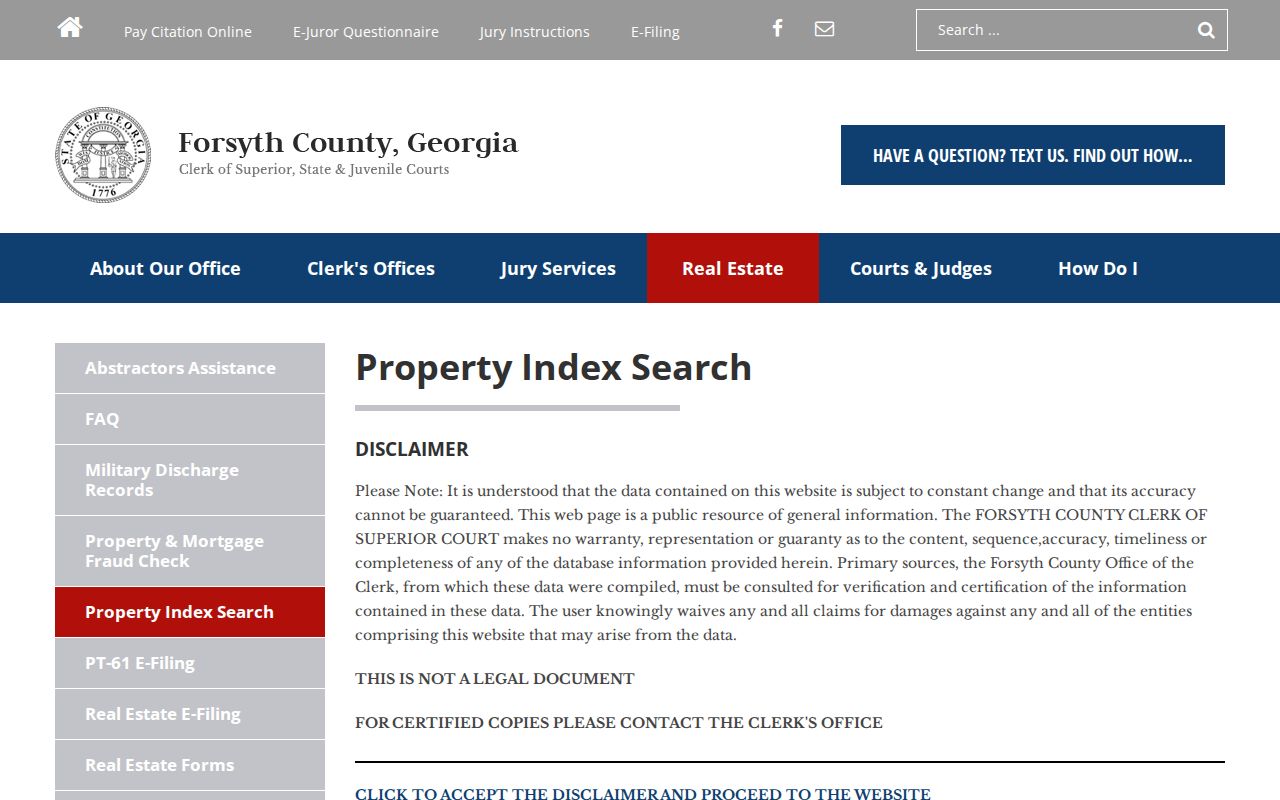
The entry point carries a warning worth heeding. Indexed information changes, and an index entry is not itself a legal document. Follow each result to the recorded image or a Clerk copy before relying on it.
Trace a Forsyth County Grantor-Grantee Chain
Start with the latest known ownership deed and work backward. An address or QPublic parcel can orient the property search. The deed's legal description and prior reference are the better controls, though, whenever the chain crosses older addresses or parcel changes.
- Locate the current acquisition deed with the present owner named as grantee.
- Record the grantor, grantee, filing date, instrument type, book/page, file number, image indicator, and legal description.
- Search that grantor as a grantee in the preceding period, then verify that the earlier deed covers the same tract.
- Repeat until the chain reaches 1980, then carry the last exact citation to the Clerk's older deed books.
Deed-index terms
- Grantor
- The party conveying the stated interest.
- Grantee
- The party receiving that interest.
- Chain of title
- The linked sequence of instruments affecting the same land.
- Book/page
- A volume and page citation for a recorded document.
- Instrument number
- A filing identifier that can point to the same recorded item.
Names alone prove little. Compare lot, subdivision, land lot, district, and metes-and-bounds language, plus related citations, before accepting any link in the chain.
Use Forsyth County's Good Thru Table as a Handoff
The Resolution Good Thru page does more than confirm that records are online. It lays out the start dates and certified-through structure for several record families. That structure tells a searcher exactly when to switch methods.
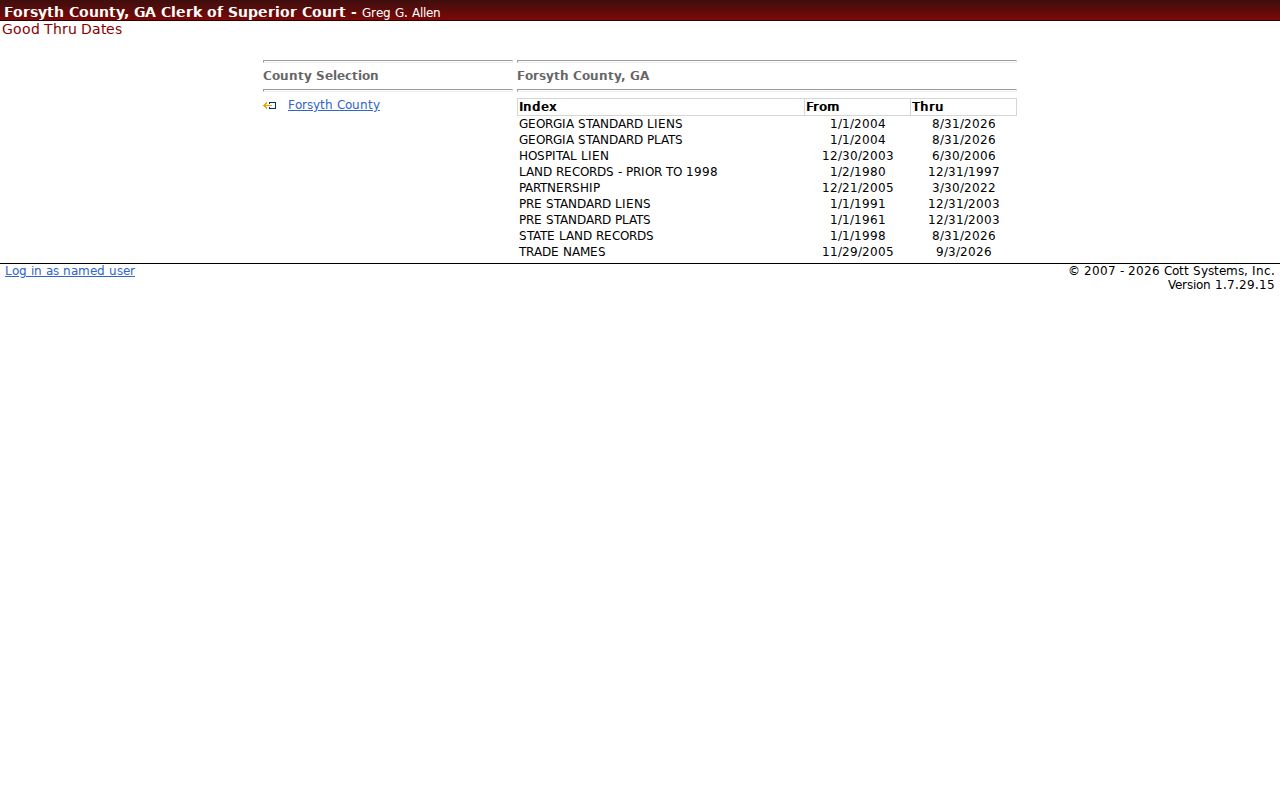
When a chain reaches past the earliest online land date, save the exact book/page, party spelling, and legal description. Those details turn a vague office inquiry into a focused older-book request.
Continue Forsyth County Deed Records Before 1980
The Clerk's physical books reach back to 1832. The office sits at 101 East Courthouse Square, First Floor, Suite 1007, Cumming, Georgia 30040, generally open Monday through Friday, 8:30 a.m. to 5:00 p.m. The main phone is 770-781-2120, and the listed email is clerkofcourt@forsythco.com. A gap online is not a lost deed. Use the older grantor and grantee indexes, staff-assisted book retrieval, and any microfilm or archival catalog. Resist importing disaster stories from other counties; Forsyth County deed records stay with the recorded books. For context, the Cumming Library's ScanPro microfilm service, Georgia Historic Newspapers, and the Forsyth County News archive can explain sales, estates, and subdivision history. They add color. The Clerk's recorded book remains the source for the conveyance itself.
Match Forsyth County Deeds to Plats and Parcels
Parcels are not static. A parcel can split, combine, or take a new identifier. Its earlier deeds keep the old description. Recorded plats establish lots of record, adjust lines, create access easements, and show subdivision phases. Compare the deed description against the plat. Do not force an old address onto a current map. The Bellehurst Phase I-B example shows the pattern. Lot 22 ties to parcel 032 733 and land lots 1072 and 1073. It also ties to Plat Book 168, pages 195 through 202. That is the identity packet to preserve: subdivision phase, lot, parcel, land lots, district or section, survey date, and plat book/page. Forsyth GIS works as a locator and cross-check, nothing more. The county says plainly that it cannot certify a boundary or replace a legal survey. So never treat a parcel polygon as part of the deed itself.
Separate the Dates and Prices in a Forsyth County Deed
Two dates matter in any Forsyth County deed. The execution date shows when the parties signed. The recording date shows when the Clerk entered the instrument into the official index. Index the deed by its recording date. But keep both dates when you rebuild a transaction. A web update stamp on QPublic or the GIS map replaces neither one.
Money figures need the same care. Consideration, sales prices, and PT-61 transfer-tax amounts appear only when the record supplies them. They describe the transaction itself. They are not the Board of Assessors' fair-market estimate. They are also not Georgia's 40 percent assessed value. A nominal figure such as ten dollars is common on deeds too. Read the whole transaction before drawing any market conclusion from it.
For a recent sale, line up four items side by side. Check the deed's parties and execution date. Check the Clerk filing date, the legal description, and the current parcel number. If the assessor still lists a prior owner of record, the county's periodic-update disclaimer explains the gap. The newest recorded deed is likely the fresher source. The county publishes no fixed lag in days for its tax roll updates.
Watch New Forsyth County Deed Filings With FANS
Georgia's Filing Activity Notification System is known as FANS. It sends free alerts when new indexed activity matches a name, address, or document you select. Enrollment is voluntary. Each request runs for one year, then needs renewal. The service only looks forward. It will not rebuild an ownership history behind you.
Set up FANS alerts after a current Clerk index check, not instead of one. An alert is a prompt to inspect the new deed. It is not proof of fraud or a title change. Notice is not guaranteed to be comprehensive. Keep your citation and return to the official index whenever an alert arrives.
Obtain a Forsyth County Deed Copy or Certification
Start with the online deed image when one is available. If that route fails, try the Resolution guest access. You can also call or email the Clerk. A visit to the Cumming counter works too, with a book/page or file number. A written request under the Georgia Open Records Act also works. Keep it focused: name the parties, record class, date range, and legal description.
Fees are listed in the Clerk FAQ. Ordinary copies run $0.50 per page. Certification adds $2.50 for the first page plus $0.50 for each additional page. Ask the office to confirm the total and the delivery method before you order. One limit is firm. The Clerk records qualifying deeds but does not prepare, witness, or notarize them. Every deed must arrive signed, witnessed, and notarized.
Recorded is not clear title. Forsyth County deed records show filed instruments, but unrecorded claims and legal defects can exist; obtain qualified title or legal review when reliance matters.
To trace owners backward through the deed records, the Forsyth County former-owner guide walks that chain in reverse. This page stays on instrument types, indexing, images, and copies.