
Reconstruct Forsyth County Former Owners by Record Era
Start with the newest verified deed. A surname search is the wrong entry point. Forsyth County deed records change collections as the chain moves back in time, so save the last book and page plus the legal-description clue before switching.
| Ownership source | Verified reach | Custodian | Best use |
|---|---|---|---|
| Property Index / Resolution | Deeds 1980 to present | Forsyth County Clerk of Court | Grantor, grantee, date, instrument, book/page and image trail |
| Physical deed books and indexes | Back to 1832 | Clerk's office in Cumming | Continue former owners before the online range |
| Recorded plats | Online ranges include pre-standard plats from 1961 | Clerk index | Lot, phase, split, combination, easement, and book/page links |
| Newspapers and microfilm | Collection-specific | Cumming Library and digital collections | Sale, estate, subdivision, and address context |
A 1990s chain can begin online. Earlier work crosses into the office books with a precise citation. Library material explains the history, but a deed remains the proof of who held the parcel.
Log Each Forsyth County Prior-Owner Transfer
Log one timeline row for each accepted instrument. Recording date, grantor to grantee, deed type, and book and page or file number all belong in the row; similar names are common, and an old book may not carry the street address. The legal description is the control field.
| Chain step | Party change | Instrument check | Identity check |
|---|---|---|---|
| Newest deed | Latest grantor to current grantee | Type, date, image, book/page | Parcel and legal description |
| Prior acquisition | Earlier grantor to latest grantor | Prior reference and vesting | Same lot, land lot, or tract |
| Older handoff | Repeat backward | Save final online citation | Carry it to the deed books |
Do not add a party just because the name appears in a security deed, lien, probate file, or tax-sale notice. Decide what interest the instrument actually conveyed.
Walk the Forsyth County Deed Chain Backward
The Forsyth Property Index is the official online entry. Its disclaimer says indexed data changes and is not a legal document. Inspect the image and seek certification when it matters.
- Find the newest ownership deed and record grantor, grantee, filing date, type, citation, and legal description.
- Search that grantor as a grantee during the earlier period, testing supported name variants.
- Confirm the same land through lot, subdivision, land lot, parcel lineage, or prior book/page.
- Repeat until the online range ends, then carry the final citation to the older Clerk indexes.
- Grantor
- The party conveying the stated interest.
- Grantee
- The party receiving it.
- Chain of title
- The linked series of instruments affecting the same land.
- Reverse index
- An index that locates acquisitions under the grantee's name.
- Quitclaim and warranty deed
- Different deed forms whose language must be read, not treated as interchangeable.
Take Forsyth County Previous Owners Beyond 1980
The online start date marks access, not record loss. Office books reach back to 1832. The Clerk's Good Thru table separates pre-1998 land records, state land records from 1998, pre-standard and standard liens, and pre-standard and standard plats.
Offline handoff. Save the final online deed's exact legal description and book/page before asking Clerk staff for the next older index range.
Find the office in Cumming at 101 East Courthouse Square, First Floor, Suite 1007. Hours generally run weekdays from 8:30 a.m. to 5:00 p.m. Ordinary copies cost $0.50 per page. Certified copies run $2.50 for the first page plus $0.50 for each added page.
See the Forsyth County Deed-Index Entry Point
The Clerk Property Index page is the official gateway.
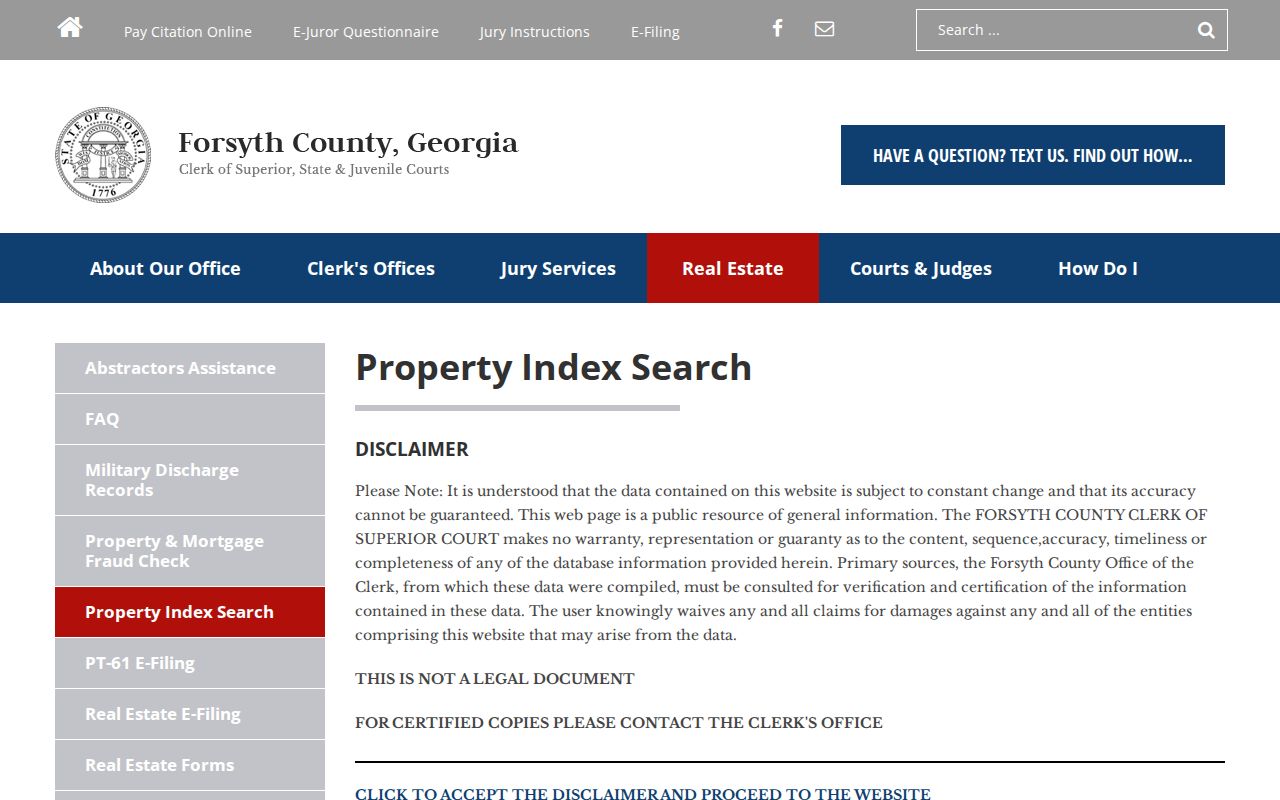
Its disclaimer advises treating index data as a lead. Inspect the recorded image, and preserve exact citations for each backward step in the Forsyth County deed chain.
Use a Forsyth County Plat to Repair an Ownership Break
Parcel splits and combinations can all break a name-to-name chain. New subdivision phases, access strips, and common areas do the same. A recorded plat repairs the gap. It ties the land to lot and book and page language. Planning reviews the plat and the Clerk records it. GIS later represents the parcel geometry once the plat is recorded.
The Bellehurst Phase I-B example shows how. It connects Lot 22 and parcel 032 733. It also ties in land lots 1072 and 1073 and Plat Book 168, pages 195 through 202. That pattern repeats countywide. Forsyth County prior-owner work should keep the phase, lot, land lot, district, and citation. An address alone is not enough.
Follow Forsyth County Former Owners Through Name and Address Changes
Initials, married names, trusts, estates, and entity captions can shift across deed records, so test the variants. Accept a hit only when the tract matches. Modern QPublic parcel IDs orient the work. Older instruments lean on metes and bounds, land lots, or prior deed references.
In 2007 USPS moved 8,678 Cumming deliveries from ZIP 30040 to 30028, so search both ZIP-era forms to recover a newspaper or directory reference. A ZIP never establishes city limits or title.
Interpret Estate and Tax-Sale Owners in Forsyth County
An executor, administrator, deed of assent, foreclosure deed, or tax deed changes the pattern. Probate inventories and death records explain timing or authority. The recorded fiduciary instrument still belongs in the land chain. The county tax-sale brochure covers the tax deed and PT-61. It says both are recorded with the Clerk within 30 days after a sale.
A name in a file is not title. Never assume a decedent, heir, bidder, purchaser, or lienholder held the land. A related record may name them without proving ownership. Compare deed type, grantee, and legal description. Weigh any redemption or priority question too.
Bridge Forsyth County Ownership History at the Library
The Cumming Library offers ScanPro microfilm access. Its eLibrary routes to Georgia Historic Newspapers, the Forsyth County News archive, Digital Library of Georgia, and genealogy tools. The library's formal history begins with a WPA-era library in 1938.
Use the library access information for sale notices, estate notices, subdivision news, and former address clues. These sources enrich house history. Each claimed owner still needs a land-record link.
Avoid a False Forsyth County Record-Loss Story
Forsyth County has no confirmed courthouse fire, flood, or catastrophic land-record loss. A missing web result just means offline access, unless the Clerk or Archives confirms a gap. Online deed records begin in 1980. Office books reach 1832.
Under the Georgia Open Records Act, request an existing record by parcel, citation, category, and date range. No custom genealogy is required of them.
Sort Forsyth County Former Owners From Other Named Parties
Forsyth County deed records mix many instrument types in one index. The index holds warranty deeds and quitclaims. It also holds security deeds, cancellations, foreclosure deeds, administrator or executor deeds, powers of attorney, right-of-way deeds, corrective deeds, plats, and liens. Not every named party is an owner. Before assigning anyone a role, read the index kind and the recorded image itself.
Some instruments do more than they appear to do. A warranty or quitclaim deed may convey the interest its text describes. A security deed relates to debt instead. Its later cancellation or satisfaction does not erase the original conveyance of ownership. A corrective deed often repairs a name. It may also repair a legal description rather than creating a whole new sale. A power of attorney may explain who signed. It vests no interest in that signer personally.
Careful notes keep the parcel history honest. Record the document type in every timeline row, and note any related instruments. That discipline stops lenders, trustees, attorneys-in-fact, heirs, and lien claimants from slipping in. None of them should enter the sequence of prior owners without deed evidence behind them.
Know the Limits of Forsyth County Former-Owner Findings
A backward chain through Forsyth County property records is a documented research trail. It is not a title opinion. Index errors, unrecorded interests, corrective instruments, and legal disputes can all distort the picture. When stakes are high, certified copies and professional review are the right response, and GIS lines remain reference geometry that cannot certify a historical description against a modern boundary.
Lawful use. Trace Forsyth County former owners for house history and property diligence, never to track, threaten, or harass a living person.
Some findings deserve professional weight. If the result affects a purchase, an estate distribution, or a dispute, obtain the relevant certified deeds and seek qualified legal or title assistance.